Why we run our own mail server after deciding not to
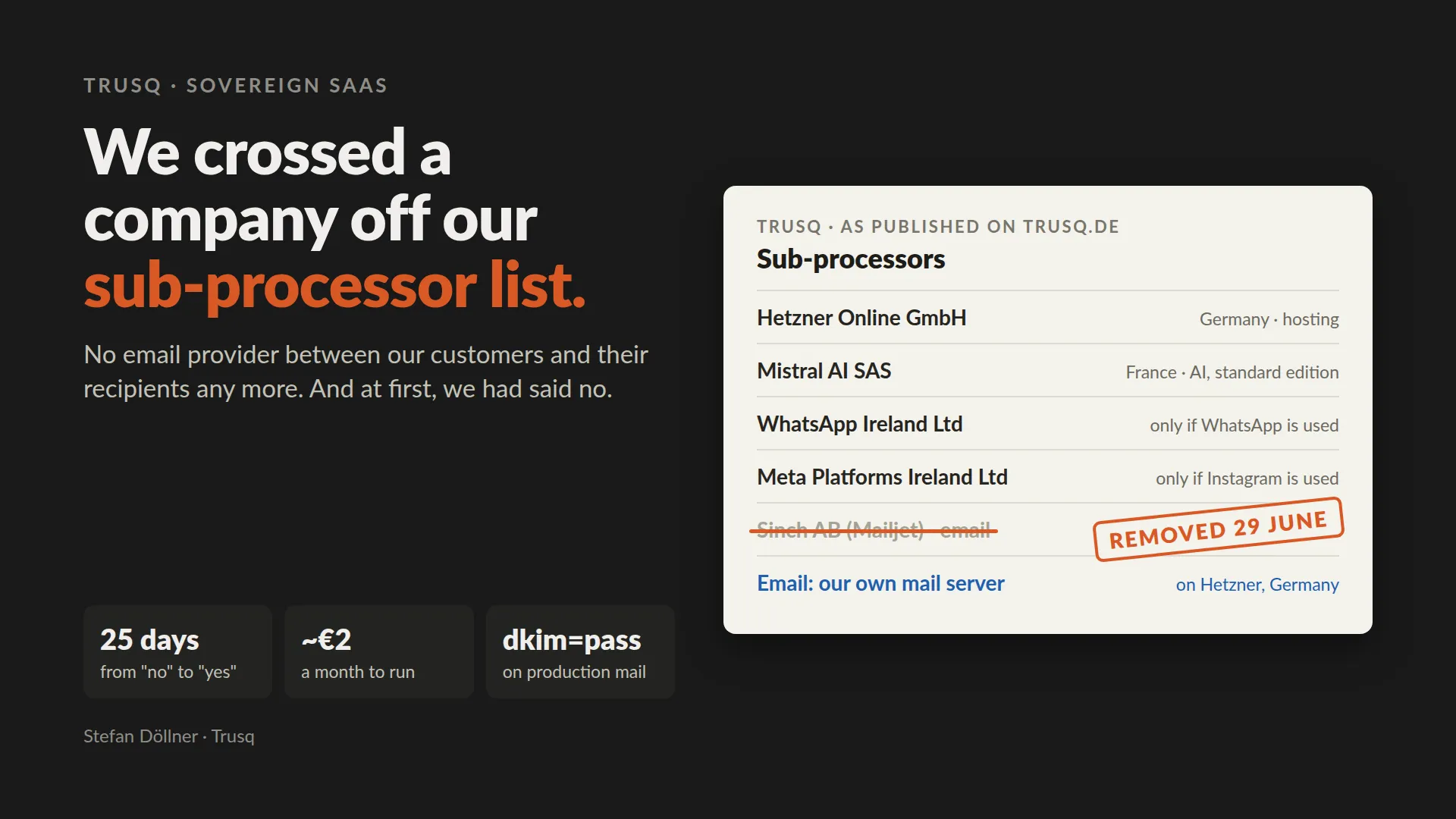
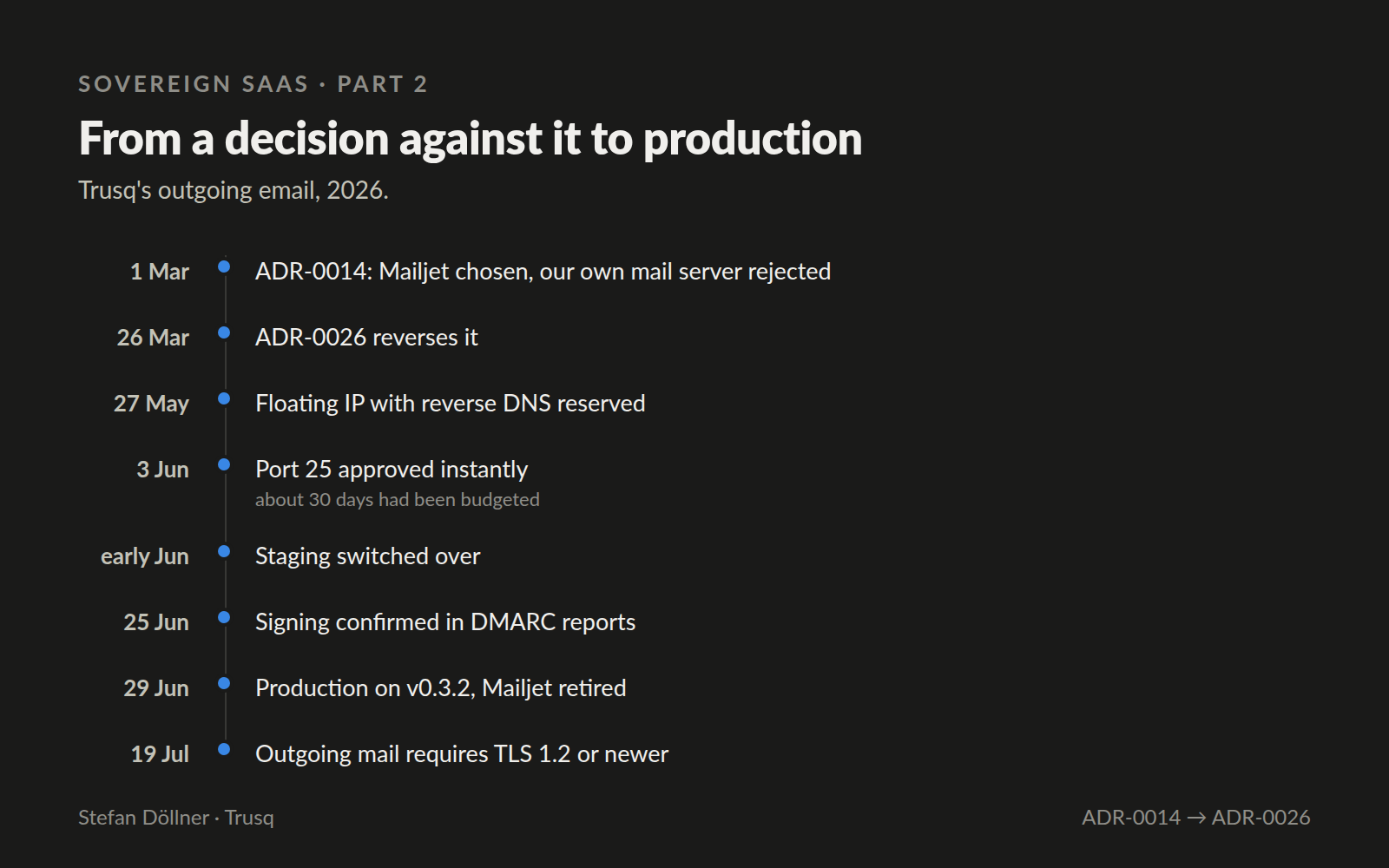
On 1 March we decided that Trusq would not run its own mail server. Twenty-five days later we decided that it would, and since 29 June every email our customers send through Trusq leaves from a mail server we operate ourselves. That took one company out of the path of our customers' email and cost us less than the service it replaced. Both decisions are written down as architecture decision records, each with its reasons, and reading them side by side shows what a good reversal rests on.
Why we first said no
Trusq sends email on behalf of its customers: when someone answers a support ticket, the reply goes out from the customer's own support address. The first decision record compared four sending services and a self-hosted mail server, and chose Mailjet, which belongs to the Swedish company Sinch and keeps its data in the EU.
The self-hosted option was rejected for sound reasons. Several of Hetzner's address ranges appear on the policy block lists that Spamhaus maintains. Port 25 is blocked on new Hetzner accounts, and unblocking it was not guaranteed. A fresh address starts with no sending reputation and needs weeks of warm-up, and a misconfigured mail server can get its address blacklisted. The verdict was "optimal GDPR posture but disproportionate operational risk".
Why we changed our mind
The second record lists seven reasons, and the most important one is about trust rather than email. Without Mailjet, the content of our customers' email never leaves infrastructure we operate, and our list of sub-processors gets one entry shorter. For a product whose customers ask exactly who processes their data, that is a sentence worth having.
The other reasons made the change cheap to attempt. Unblocking port 25 now looked achievable. Our volume was low, so the warm-up period would touch few recipients and be easy to watch. Mailjet's fee would go away. The automation for setting up customer domains at Mailjet had not been built yet, so switching threw no work away. And the code that sends email already sat behind a small interface with a single method, so a mail server could replace the provider without changing anything that calls it.
The record also kept the old counter-arguments in writing, operational burden first among them. We reversed the decision knowing exactly which risks we were taking on, which is what made it possible to plan for each of them.
What we built
The setup is Postfix with OpenDKIM, running in our own Kubernetes cluster on Hetzner in Germany, and it covers what a sending service used to do for us:
- A dedicated sending address. Outgoing mail leaves from a fixed floating IP whose reverse DNS entry matches our sending domain, so receiving servers can check that the address and the domain belong together.
- Signatures per customer domain. Customer domains get their own DKIM signing keys, stored encrypted, and a rotated key stays valid for a week, so mail signed with it still verifies while it is on its way.
- Encryption in transit, required. Since July outgoing mail demands TLS 1.2 or newer from the receiving server instead of encrypting only when the other side offers it.
- Bounce handling. Delivery reports are parsed, and addresses that bounce hard go on a suppression list, which protects the reputation of the sending address.
- Trust checks on incoming mail. SPF and DKIM results decide whether a reply may reopen a resolved ticket, and every AI-drafted reply carries the
Auto-Submittedheader, so two autoresponders cannot keep answering each other. - Guardrails in the pipeline. A network policy limits which of our services can hand mail to Postfix, and a check in our build pipeline fails any configuration that would make the outgoing mail server reachable from the internet.
How it went
The risk we had worried about most turned out to be the smallest. We had budgeted about 30 days for Hetzner to open port 25, and the request was approved instantly on 3 June. Staging switched over first, in early June, and production followed with version 0.3.2 on 29 June, the day we retired Mailjet.
The DMARC aggregate reports that receiving mail servers send back are how we know it works. They show our production mail as signed and aligned, with dkim=pass and spf=pass. Reading those reports from the first day was the most useful habit of the whole project: in the first weeks they caught a signing problem that nothing on our own side would have shown, and we fixed it before production switched over for good.
What it gave us
One company fewer in the path of our customers' email, and a sub-processor list that is easier to explain. Running costs of about €2 a month for the floating IP and the mail server's share of a node, instead of a fee that grows with volume. And full control over how customer domains are set up, without an integration with someone else's API.
What we took on is the work a provider's deliverability team used to do: watching reputation, reading reports, keeping the configuration tight. That is a real commitment, and we made it knowingly.
What carries over
Write the reasons down when you decide, including the reasons against. A reversal is then a comparison of two lists instead of an argument about who remembers what, and the second list can say honestly which risks it accepts.
Keep anything you might replace behind a small interface. The switch from a provider to our own mail server touched no caller, and that is a large part of why it was a reasonable bet.
And when you take over a job a provider used to do, set up the feedback it used to get before you need it. For email, those are the reports other mail servers send back, and they have been worth more to us than any dashboard of our own.