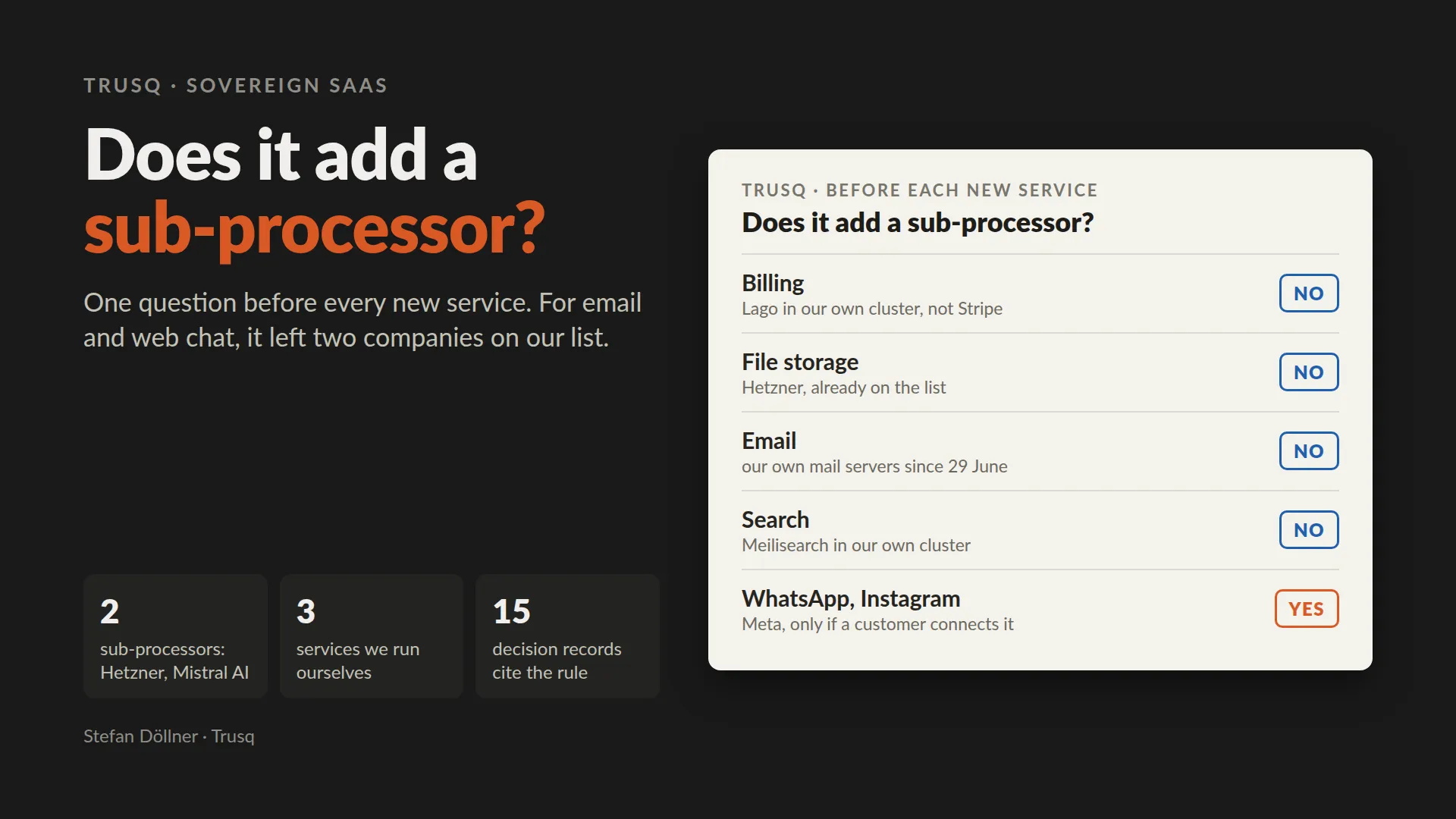
Does it add a sub-processor?
A Trusq customer who answers email and web chat with us has exactly two sub-processors: Hetzner, which runs the whole platform in Germany, and Mistral AI in France, which provides the language models. The mail servers, the search index and the billing system all run on our own servers. That is not an accident of being small. It comes from one question we ask before every new service: does it add a company that will see our customers' data?
The rule
We wrote the rule down in February, when we chose Hetzner for hosting and Mistral for AI. Every sub-processor must be incorporated in the EU, without a US parent company. An EU subsidiary of a US company does not pass, because the parent remains subject to the CLOUD Act and FISA Section 702, wherever the subsidiary stores the data.
The rule has a second half that matters just as much. A service we run ourselves is not a sub-processor at all. So when an open-source option exists that a small team can operate, we run it on our own servers instead of adding a provider.
Where the question decided
Billing. Stripe, Chargebee and Recurly were out before we compared features, because each of them is a US company or the subsidiary of one, Stripe's Irish entity included. We run Lago, an open-source billing system from a French company, inside our own cluster, so billing data never leaves our infrastructure. The payments themselves go through Mollie in the Netherlands, which receives no ticket content and no data about our customers' customers. For our own fees we are the controller, so Mollie is on our list, but not as a sub-processor.
File storage. Attachments, data exports and invoices need object storage. We compared Amazon S3 in an EU region with Hetzner's object storage. Amazon would have added a new company to the list, and Hetzner was already on it. So file storage added nothing.
Email. Since 29 June we send and receive every email on our own mail servers in Germany, and the email provider we had used before is gone from the list. How we first decided against it and then reversed that decision was last week's article.
Search. The search index holds a copy of every ticket and every contact, which makes it one of the most sensitive pieces of the system. It runs as Meilisearch inside our own cluster, so that copy never sits with a search provider.
Each of these choices has a price: a service we run is a service we have to update, monitor and fix ourselves. For a small team that is real work, and we accepted it each time with the list in front of us.
The one exception
WhatsApp and Instagram belong to Meta, and there is no way to reach someone on WhatsApp without it. So WhatsApp Ireland and Meta Platforms Ireland are on our list, marked as what they are: sub-processors with a US parent, used only when a customer connects that channel. A customer who never connects them never sends any data there. A rule with one documented exception is still a rule, as long as the exception is visible to everyone who reads the list.
Why the short list pays off
German procurement teams read sub-processor lists line by line. Every entry is one more contract to check, one more transfer to assess and one more company to trust. Our list for email and web chat fits on a phone screen, and a data protection officer can check it in a few minutes.
It also keeps us honest over time. We have to announce every new sub-processor to our customers thirty days before we use it, and they can object. A question asked before each decision is much cheaper than an announcement after it.
What carries over
If a constraint matters to your customers, give it a name where decisions are made, not only in a policy document. Ours is a requirement with its own ID in the product requirements and the architecture constraints, and 15 of our architecture decision records cite it by that ID as a hard constraint. Nobody has to remember the rule, because every option is checked against it before anything is chosen.