Why Trusq runs open-weight models, even in the cloud
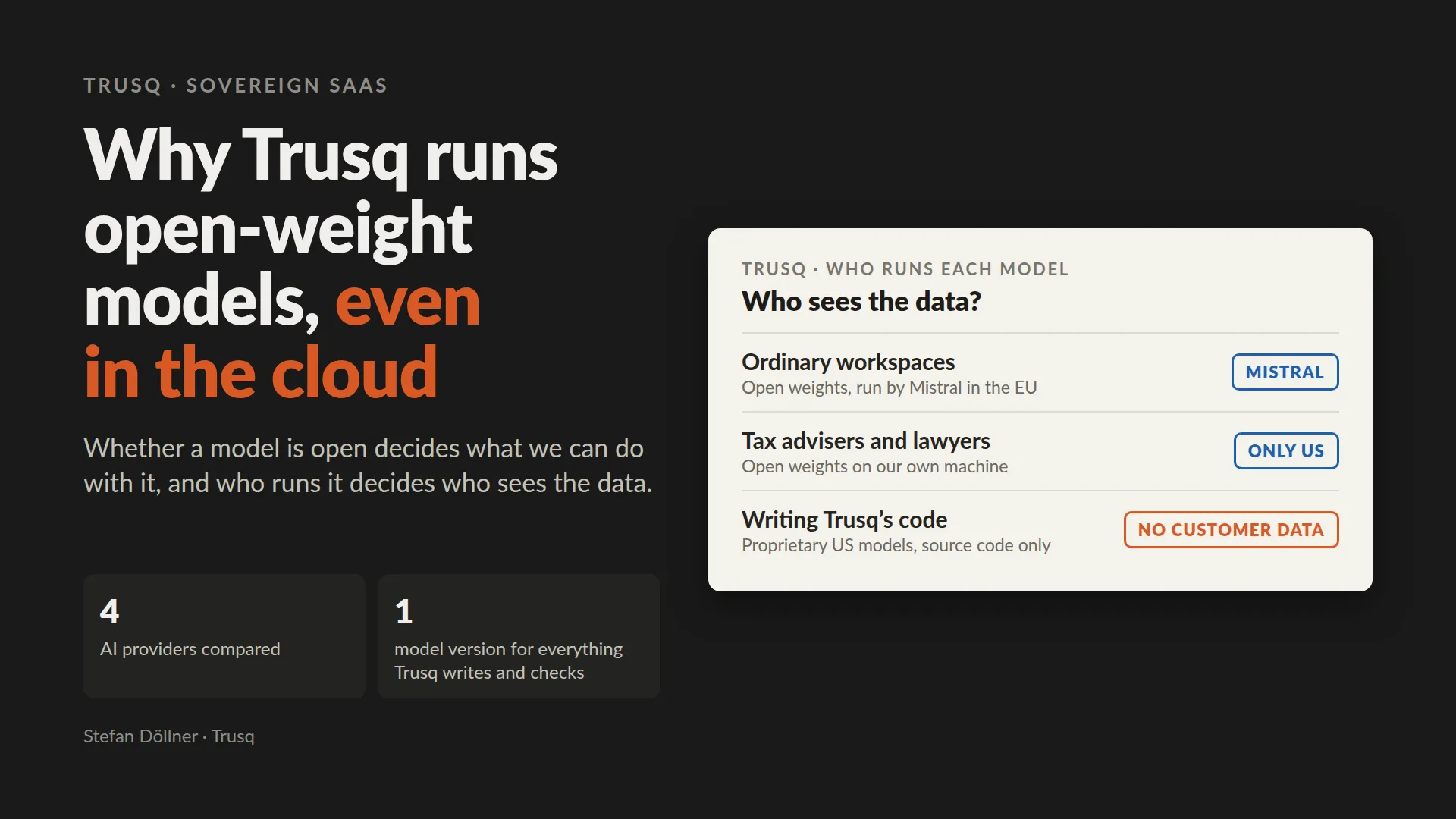
Every model that writes, classifies or checks text in Trusq has open weights. For ordinary workspaces, none of them runs on our own servers: Mistral runs them in its cloud in the EU. For a separate track for tax advisers and lawyers, we run open-weight models on a machine we operate ourselves. Whether a model is open decides what we can do with it, and who runs it decides who sees the data.
Who runs the model
When a model runs on someone else's servers, every request takes your customers' data there. Under the GDPR that makes the operator a sub-processor, and the law the operator answers to becomes part of your product. It makes no difference whether the weights are open, because an open-weight model served by a provider is still that provider's service.
When we chose Trusq's AI provider, we compared four options: Mistral, Azure OpenAI in an EU region, the US APIs of Anthropic and OpenAI, and self-hosted open weights. An EU region did not solve the problem. Microsoft is a US company, so a model in its West Europe data centre still adds a US sub-processor, and the CLOUD Act reaches the parent wherever the data is stored. Trusq's rule is no US sub-processors in the core data pipeline, so the hosted track runs on Mistral, which is incorporated in France.
What open weights give us in the cloud
A proprietary model exists only as its vendor's service. If the vendor retires it, changes it or stops offering it in the EU, the model is gone. An open-weight model is a file that anyone can download, and the provider is only the one who runs it for us. At the end of October, Mistral retired a model version we had measured on staging. With open weights, that ended one provider's offer and not the model itself.
The same property makes the separate track possible. A model we can download is a model we can run on our own hardware, so the hosted track and the self-hosted track can use the same kind of model. Moving a workspace from one to the other then changes who runs the model, but not what the model is.
Open weights do not stop a provider from changing what answers behind a name. That is why production names its model by the provider's specific version id, never by an alias like "latest", and why a model change is a commit that someone reviews. One id feeds every generation the hosted track makes, so a change there moves classification, replies, summaries and the check of each reply at once.
Where we use proprietary models
Most of Trusq's code is written by coding agents on cloud subscriptions, and those models are proprietary and American. That follows the same rule, because what those sessions see is source code. Customer data never reaches them.
Running open weights yourself is no longer exotic either. On my own server at home, built from used parts for €3,060, a 125-billion-parameter open-weight model writes 55 to 69 tokens per second. I give it my private data, because no prompt leaves the house.
The checks that remain
Self-hosting removes the sub-processor, but not every question about origin. Three checks come before any benchmark:
- The licence. Some open-weight licences forbid commercial use, allow only research, or exclude whole regions.
- Provenance. Where the weights come from, and whether the file you run is the file that was published. A checksum against the publisher's release is the minimum.
- The AI Act. Running a model yourself can change what you are responsible for. That is a question for a lawyer, not an assumption.
Sort by data, not by model
For every AI component in your stack, write down three things: which data reaches the model, which company operates the server it runs on, and whether you could take the model elsewhere if that company changes its offer. The first two decide where a hosted API is acceptable. The third is where open weights pay off, even when someone else runs them.